



Live US Stocks
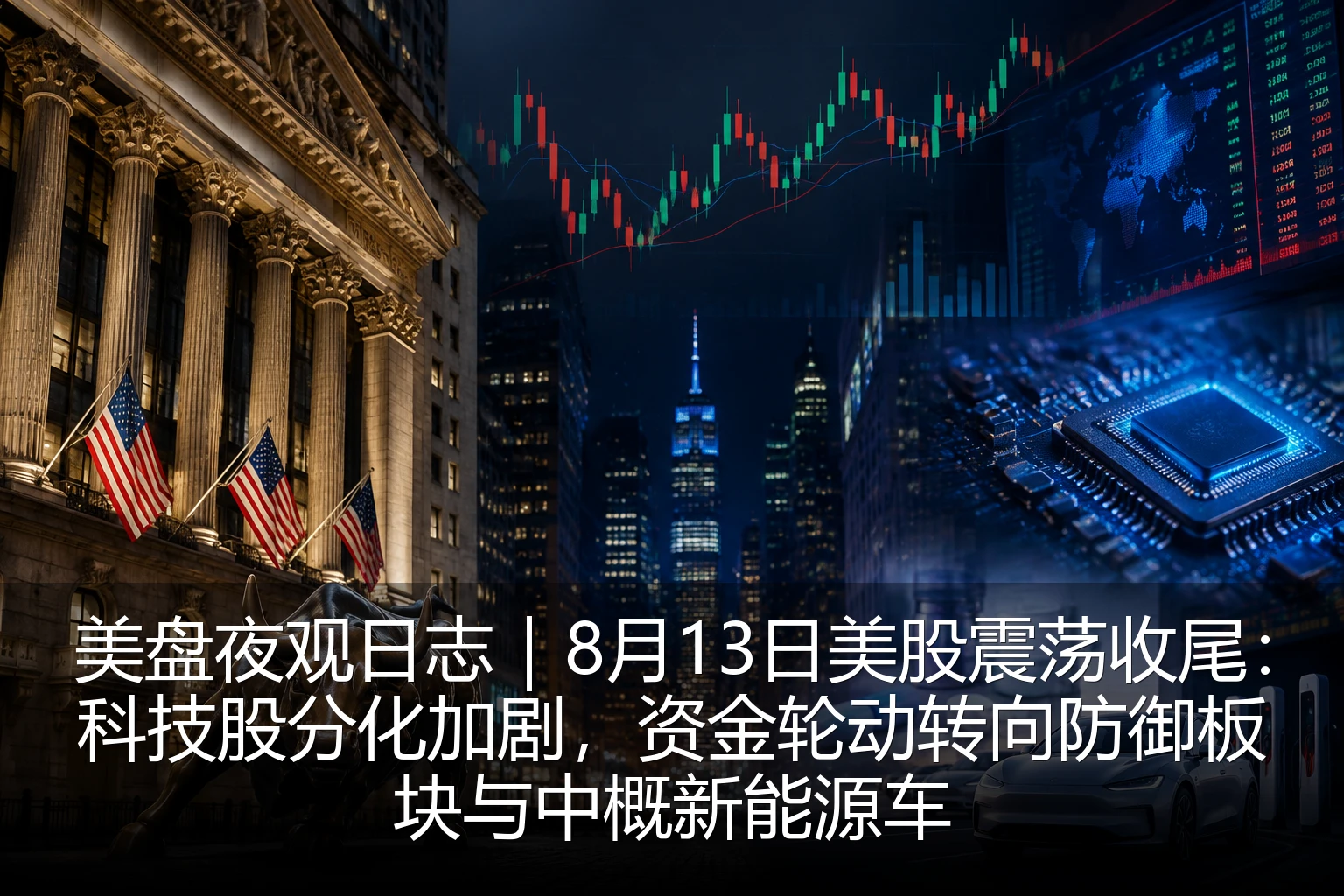
US Market Night View | August 13: US Stock Volatility Ends: Technology Stocks Divergence Intensifies, Capital Rotation Shifts to Defensive Sectors and Chinese New Energy Vehicles
CategoriesLive US Stocks
Publish Time2026-08-14
## I. Overnight US Stock Market Overview: Three Indices Show Divergence, Tech Stocks Under Pressure
As of August 13, Beijing Time, the three major US indices concluded a period of volatility. The Dow Jones Industrial Average Index (DJIA) rose slightly by 0.3%, closing above 38,500 points; the Nasdaq Composite Index (IXIC) fell slightly by 0.2%, near 15,800 points; and the S&P 500 Index (SPX) remained flat, closing at the 5,200 point level. Overall, market sentiment is cautious, with capital rotating clearly between sectors. Tech stocks are becoming a focus of adjustment due to valuation pressure and earnings divergence, while defensive sectors are favored for their stability.
Looking at trading volume, overnight US trading volume was slightly lower than the previous day, indicating that investor sentiment is warming up with watchful waiting. The rise in the Dow was mainly supported by defensive sectors, while the decline in the Nasdaq was driven by the diverging performance of the seven major tech giants. The flat S&P 500 reflects market caution regarding US Federal Reserve policy expectations and the balance in sector rotation.
## II. Technology Sector: AI Hardware Retreat, Divergence Among Seven Tech Giants Intensifies
### 1. AI Hardware Sector: Capital Flows Out Under Valuation Pressure
The AI hardware sector has become a focus for adjustment in overnight US stocks, with performance diverging among chip stocks represented by NVIDIA (NVDA). NVIDIA saw a slight rebound, closing up 1.5%, due to news of earlier production of the Blackwell Ultra chip. However, Amazon (AMZN) fell 1.2% due to slowing growth in cloud services, while Microsoft (MSFT) slightly declined by 0.5% due to concerns about capital expenditures. Analysts point out that after a significant rise in the AI hardware sector, valuations are at historic highs, leading investors to focus on the sustainability of earnings, causing capital outflow.
The rebound in NVIDIA was mainly due to the production progress of its Blackwell Ultra chip, the latest product in the AI computing field, which is expected to further increase NVIDIA's market share. Amazon's decline reflects the intensifying competition in the cloud services market, as the growth rate of its AWS division was below expectations, leading to concerns about its future profitability. Microsoft's slight dip is related to capital expenditures, as the market worries that its AI investments might affect short-term profits.
### 2. Seven Tech Giants: Capital Rotation Accelerates
The performance of the seven tech giants (Apple, Microsoft, Google, Amazon, NVIDIA, Meta, Tesla) shows clear divergence, with capital rotating among the giants. NVIDIA and Tesla rose on positive news, while Amazon and Meta fell on negative news. This divergence reflects different expectations for the fundamentals of the tech giants and the cautious attitude of capital towards high-valuation stocks.
Tesla (TSLA) rose 2.1% above expectations in its Q2 earnings report, with delivery volumes reaching a new record, indicating strong demand in the new energy vehicle market. Apple (AAPL) fell slightly by 0.3% due to pressure in the Greater China sales region, but AI investment remains a key variable for its profits, and the market remains optimistic about its future growth. Google (GOOGL) saw a slight rise of 0.1% due to stable advertising growth, while Meta (META) fell by 0.8% due to widening losses in the metaverse business.
## III. Defensive Sectors: Consumer Goods and Healthcare Become Safe Havens for Capital Defensive sectors showed strong performance in overnight US stocks, with consumer and healthcare sectors becoming safe havens for funds. Walmart (WMT) rose by 0.8% due to better-than-expected second-quarter retail sales growth, Johnson & Johnson (JNJ) rose by 0.6% due to stable demand for medical equipment, and Pfizer (PFE) rose by 0.4% due to stable revenue from vaccine business. The rise in these sectors reflects investors' concerns about economic uncertainty and their pursuit of stable returns. The rise in the consumer sector is mainly due to the resilience of retail sales; Walmart, as a retail giant, reflects consumer purchasing power in the US. The rise in the healthcare sector is related to the aging population trend, as Johnson & Johnson and Pfizer are companies in medical equipment and pharmaceuticals with stable cash flows. The rise in defensive sectors offset the decline in tech stocks on the broader market, keeping the S&P 500 index flat.
Chapter Four: Overnight Chinese Stocks: New Energy Vehicles and Solar Sectors Attract Capital Against the Trend
1. New Energy Vehicle Sector: Earnings Reports Drive Gains
The Chinese new energy vehicle sector performed outstanding in overnight US stocks. Tesla (TSLA) rose by 2.1% due to better-than-expected Q2 earnings, BYD (BYDDY) rose by 1.8% due to record deliveries, and NIO rose by 1.5% due to expectations for new model releases. The gains in these companies are mainly due to improvements in their fundamentals and optimistic market expectations for the new energy vehicle industry. Tesla's Q2 earnings showed deliveries of 1.6 million vehicles, a year-on-year increase of 15%, and net profit increased by 20%, exceeding market expectations. BYD's deliveries reached 800,000 vehicles, a year-on-year increase of 12%, with battery business and new energy vehicle business growth becoming the main drivers. NIO released the new model NIO ET9, expected to increase its market share, and the market holds optimistic views on its future growth.
2. Solar Sector: Policy Support and Demand Growth
The Chinese solar sector also performed well. JKS rose by 1.2% due to growing demand in the European market, LONGi rose by 1.0% due to technological advancements, and SHE rose by 0.8% due to adjustments in US tariff policies. The gains in these companies are mainly due to policy support and the growth in global solar demand, as well as their leading position in technology. JKS's growth in the European market is mainly due to the EU's "Green Deal," where the market share of its solar components is continuously increasing in Europe. LONGi's technological advancements have lowered its costs, improving the competitiveness of its products. SHE's adjustment in US tariff policies reduced its export costs, enhancing its competitiveness in the US market.
Chapter Five: Capital Flows: Foreign Investment Flows into Defensive Sectors and Chinese New Energy Vehicles
Overnight US stock capital flows show that foreign investment mainly flows into defensive consumer and healthcare sectors, as well as the Chinese new energy vehicle sector, while flowing out of the AI hardware sector. According to Bloomberg data, net inflow to defensive sectors reached $5 billion, net inflow to the Chinese new energy vehicle sector reached $3 billion, while net outflow from the AI hardware sector reached $4 billion. The reason for foreign investment into defensive sectors is that these sectors have lower valuations and stable cash flows, making them suitable for long-term investment. The reason for inflow into the Chinese new energy vehicle sector is the improvement in their fundamentals and the market's optimistic expectations for future growth. The reason for outflow from the AI hardware sector is their overvalued status and increased earnings uncertainty, leading investors to avoid risk. ## VI Impact of Fed Policy: Cautious Rate Cut Expectations, US Treasury Yields Rise
The rate cut signals released after the Federal Open Market Committee meeting in July still influence market sentiment, but recent remarks by Fed officials indicate that rate cuts will remain cautious. Fed Chair Powell emphasized in his speech on August 12 that rate cuts depend on continued improvement in inflation data, and inflation is still at a high level, so the timing for a cut is not yet ripe.
Changes in US Treasury yields also reflect market expectations for Fed policy. Overnight, the 10-year Treasury yield rose to 4.2%, up 5 basis points from the previous day. The rise in Treasury yields puts pressure on high-valuation technology stocks because higher risk-free rates reduce the valuation of tech stocks. At the same time, the rise in Treasury yields increases the attractiveness of defensive sectors because their yields are relatively stable.
## VII Asia Opening Sentiment Forecast: FTSE A50 May Rise Slightly, Hang Seng Index Volatile
Based on overnight US stock performance, Asia opening sentiment is expected to be divided. FTSE A50 futures (HSI) may rise slightly due to support from the Chinese new energy vehicle sector and defensive sectors. The Hang Seng Index may be volatile due to the divergence in US stock movements. The Nikkei 225 index may slightly decline due to adjustments in technology stocks.
The rise in FTSE A50 futures is mainly driven by the performance of the Chinese new energy vehicle sector and support from defensive sectors. The volatility of the Hang Seng Index is due to the divergence in US stocks and factors specific to Hong Kong stocks, such as mainland economic data and policy expectations. The slight decline in the Nikkei 225 is due to adjustments in technology stocks and the impact of the yen exchange rate.
## VIII Summary: Capital Rotation Becomes Market Main Trend, Defensive and New Energy Vehicles Become Focal Points
The overnight US stock trend shows that capital rotation is becoming the market main trend, with defensive sectors and Chinese new energy vehicles becoming focal points for capital. Technology stocks are affected by valuation pressure and earnings divergence adjustments, while defensive sectors are favored for their stability. Chinese new energy vehicles are attracting capital due to improving fundamentals against the trend, indicating optimistic expectations for future growth from the market. Cautious expectations for Fed policy and rising Treasury yields will continue to influence market sentiment; investors should focus on opportunities in sector rotation.
For the Asia market, a slight rise in FTSE A50 futures signals positive sentiment for the Asia opening, but the volatility of the Hang Seng Index reminds investors to be cautious. Investors should focus on opportunities in defensive sectors and Chinese new energy vehicles while avoiding the risks of high-valuation technology stocks.
This website content is for educational and informational exchange purposes only. We do not provide any financial services, such as account opening, margin lending, discretionary asset management, or insider trading. Please do not trust any private messages on this site that recommend stocks or induce following trades.