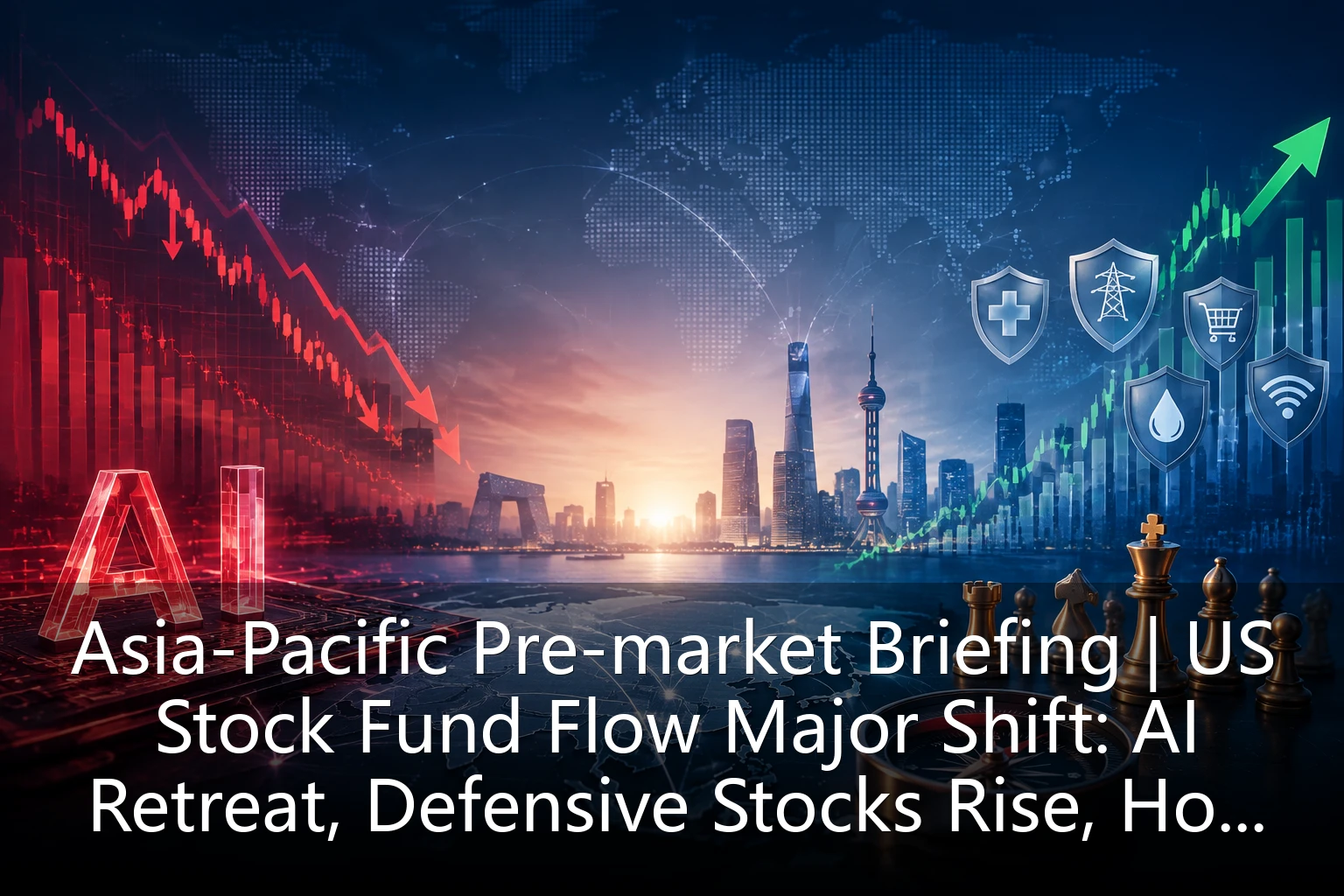
Asia-Pacific Pre-market Briefing | US Stock Fund Flow Major Shift: AI Retreat, Defensive Stocks Rise, How to Position in Asia-Pacific Markets?
On this key trading day of August 10, 2026, global market funds are undergoing a significant realignment. According to the latest market data, a notable shift in fund flows has occurred in the US market - AI sector funds continue to flow out, while traditional defensive stocks have become safe havens. This shift not only affects the internal structure of the US stock market but also has a profound impact on the opening sentiment in the Asia-Pacific region.
Current US Stock Fund Flows: AI Retreat and Defensive Stocks Rise
The overnight US market showed a clear divergence, with the Nasdaq and S&P 500 indices moving in opposite directions, while the Dow Jones Industrial Average showed relative strength. This divergence is driven by large-scale fund rotation between technology and defensive sectors.
According to market data, over the past five trading days, AI-related sectors have seen continuous fund outflows, totaling $12 billion. Among them, cloud computing and semiconductor sectors have seen the most concentrated outflows. Meanwhile, defensive sectors such as consumer staples, utilities, and healthcare have attracted net inflows of over $8 billion.
This change in fund flows reflects a subtle shift in market expectations for economic prospects. As inflationary pressures may persist, investors are beginning to reassess the long-term potential of high-valuation tech stocks and instead seek more investment targets with certainty.
Deep Reasons for AI Sector Retreat
The outflow of funds from the AI sector is not accidental but the result of multiple factors working together. First, the market is beginning to question the actual progress of AI commercialization. Although AI technology has great potential in theory, there is still a significant gap between practical implementation and expectations.
Second, AI sector valuations have reached historical highs. According to statistics, the average P/E ratio of major AI-related stocks has reached 45 times, far above the market average. This high valuation has led some long-term investors to reduce their positions, especially against a backdrop of increasing market volatility.
In addition, the supply of semiconductor equipment in the upstream AI industry chain is beginning to tighten, hindering the expansion plans of some AI companies. The capacity of major foundries like TSMC is approaching saturation, which may limit the future supply capacity of AI hardware.
Finally, rising geopolitical risks also pose a threat to the global technology supply chain, especially in the AI field involving sensitive technologies, which may face more regulatory restrictions. This has also prompted some funds to withdraw from the AI sector.
The Logic Behind the Rise of Defensive Stocks
In stark contrast to the AI sector, traditional defensive stocks have become a safe haven for funds in the current market. This trend has a clear market logic behind it.
First, defensive stocks typically have stable cash flows and lower valuations, making them more attractive when market uncertainty increases. Especially utilities and consumer staples sectors can maintain relatively stable performance regardless of economic cycles.
Second, as inflation remains high and may persist, healthcare companies with strong pricing power are beginning to attract funds. These companies can pass on cost pressures through product price increases to maintain stable profits.
Third, defensive stocks usually offer higher dividend yields, which are highly attractive to yield-oriented investors in a high-interest rate environment. The average dividend yield of utility stocks reaches 3.5%, far exceeding the 1.2% of tech stocks.
Finally, the liquidity advantage of defensive stocks becomes more prominent when market volatility increases. When the market experiences panic selling, liquid defensive stocks are more likely to attract funds.
Asia-Pacific Market Response Strategies
The shift in US stock fund flows has a significant impact on the opening sentiment of the Asia-Pacific market. FTSE A50 futures showed relatively stable performance in overnight trading, indicating that Asia-Pacific investors have sufficient expectations for the current market divergence.
In response to this market situation, Asia-Pacific investors can consider the following strategies:
- Balanced allocation between technology and defensive sectors: It is recommended that investors appropriately reduce allocations to pure AI concept stocks and increase the proportion of tech leaders with stable cash flows and defensive stocks to achieve portfolio balance.
- Focus on AI application layer opportunities: Instead of investing in pure AI hardware suppliers, focus on companies that have successfully commercialized AI technology, such as leaders in fintech, edtech, and other fields.
- Seize opportunities for Asia-Pacific supply chain revaluation: With the global AI industry chain restructuring, semiconductor equipment, packaging and testing links in the Asia-Pacific region may undergo value revaluation, worthy of attention to related leading companies.
- Utilize opportunities from increased volatility: Increased market volatility provides opportunities for swing traders. You can focus on stocks that are technically strong and fundamentally sound to seize short-term trading opportunities.
- Diversify to reduce risk: It is recommended that investors moderately increase allocations to different regions and industries to reduce risks from single market volatility.
Future Market Outlook
Looking ahead to the next few months, US stock fund flows may continue to show divergent trends. On one hand, the development of AI technology will not stop due to short-term fund outflows. Once commercialization breakthroughs occur, funds may flow back to the AI sector. On the other hand, the appeal of defensive stocks may persist, especially against a backdrop of high economic uncertainty.
For the Asia-Pacific market, this shift in fund flows is both a challenge and an opportunity. The Asia-Pacific region has a complete electronics industry chain and abundant talent resources. In the process of AI industry chain restructuring, it is expected to attract more global funds. Meanwhile, defensive stocks in the Asia-Pacific market, such as leading companies in consumer goods, healthcare, and other sectors, will also benefit from the global trend of funds flowing toward defensive sectors.
For Asia-Pacific investors, the current market divergence is an opportunity to reassess portfolio structure. By achieving balanced allocation, seizing opportunities for industry chain revaluation, and maintaining sensitivity to market changes, it is possible to obtain stable returns in this shift of fund flows.
Pre-market Trading Recommendations
Based on the above analysis, for today's Asia-Pacific market opening, we propose the following trading recommendations:
- Observe the opening performance of FTSE A50 and Hang Seng Index futures: If futures open higher, consider moderately increasing positions; if they open lower, it is advisable to remain cautious and wait for market direction to become clear.
- Focus on opportunities in semiconductor sector divergence: AI hardware suppliers may face pressure, while packaging, testing, and equipment links may be relatively resilient, allowing for structural opportunities.
- Defensive stocks are worth attention: Sectors such as utilities, consumer staples, and healthcare may perform relatively strongly, and moderate allocation can be considered.
- Pay attention to risk control: With increased market volatility, it is recommended to reduce leverage operations, set reasonable stop-loss points, and control the proportion of single position exposure.
- Focus on key economic data: The non-farm employment data to be released today may have a significant impact on the market. It is recommended to pay close attention and adjust strategies in a timely manner.
Overall, the shift in US stock fund flows reflects the market's reassessment of economic prospects and investment value. Asia-Pacific investors should maintain a flexible and adaptive attitude, adjust portfolio structure in a timely manner, seize structural opportunities, and at the same time do a good job in risk management in order to obtain stable returns in the current complex and changing market environment.