Intel's Strong Earnings Drive Stock Surge, Tech Giants Suffer Heavy Sell-off: A Market of Stark Contrast
After a seemingly ordinary trading day, global capital markets welcomed two contrasting scenes in the early hours of July 24, Beijing time. On one side, Intel posted earnings that fully beat expectations, sending its after-hours stock price surging over 13%, demonstrating a strong recovery. On the other side, the three major US stock indices fell sharply, with the "Big Seven" tech giants led by Tesla and Google suffering a heavy sell-off, collectively losing about $800 billion in market value — the worst single-day performance since April last year. This picture of "fire and ice" profoundly reveals the complex sentiment of global investors toward the outlook for the tech industry.
Intel Earnings Shine After Hours: Strong Recovery Amid Supply Shortage and AI Computing Demand
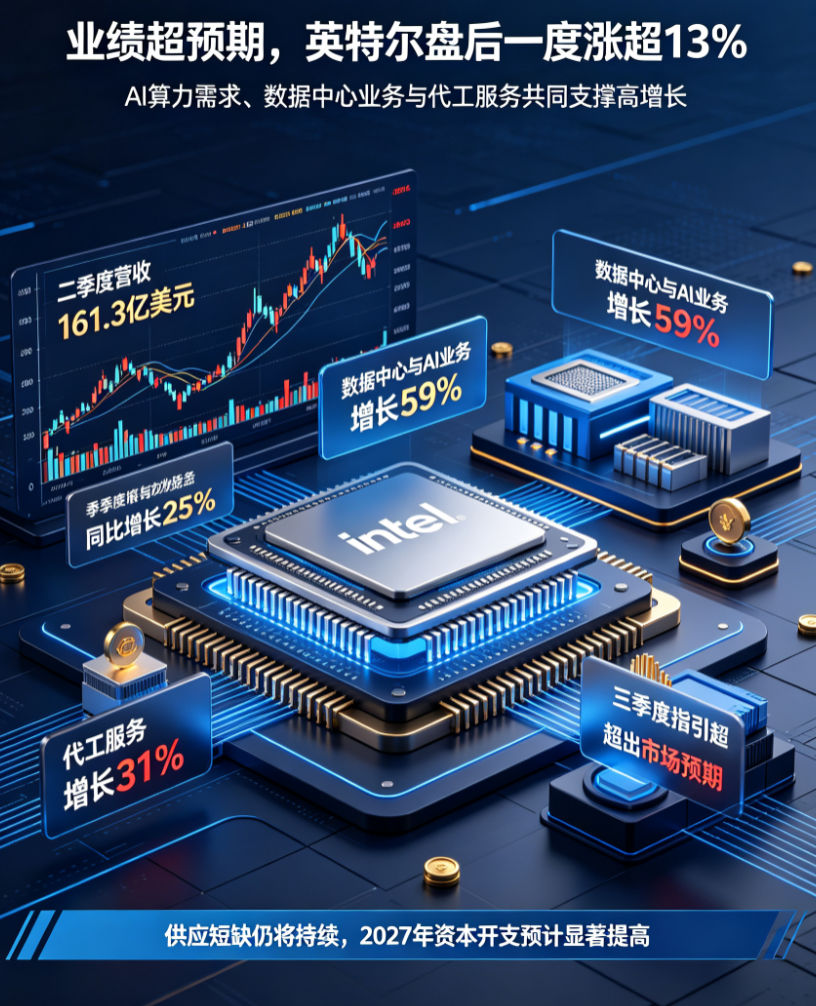
Intel delivered an encouraging report card after the US market close. The earnings showed that in the second quarter of 2026, Intel's revenue reached $16.13 billion, up 25% year-over-year, significantly beating market expectations of $14.43 billion, achieving its strongest quarterly revenue growth in nearly 15 years. Adjusted earnings per share (EPS) came in at $0.42, also far exceeding analysts' estimate of $0.21.
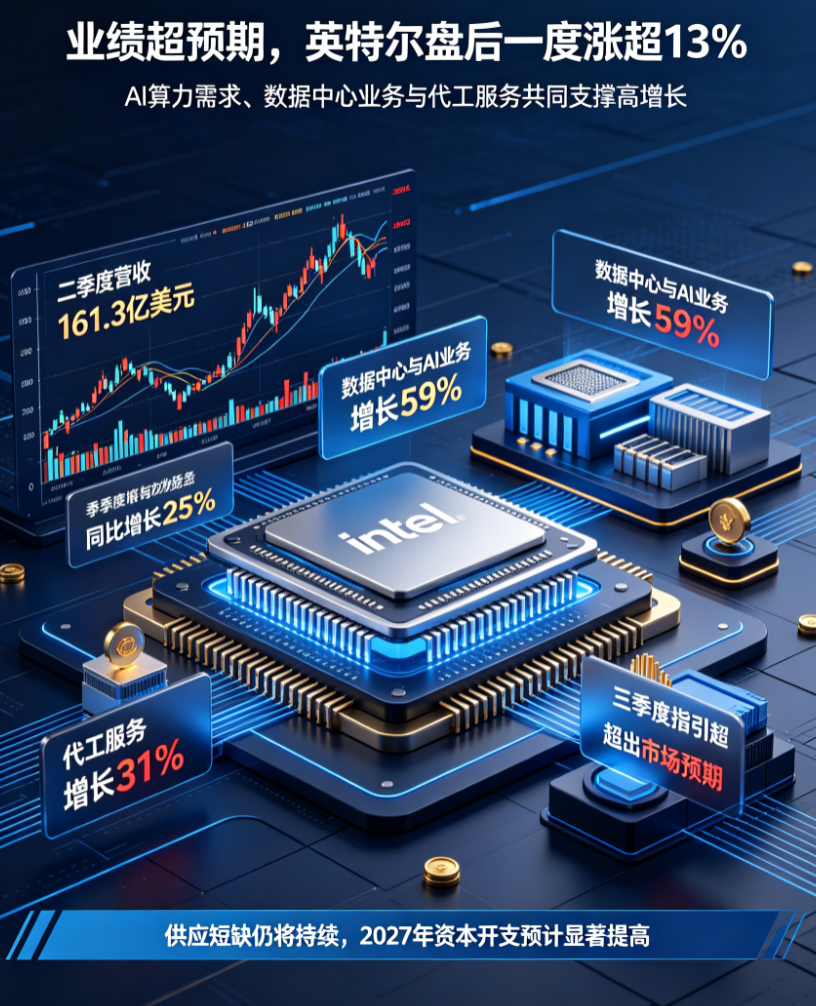
This outstanding performance was not limited to the top line; all core business units showed strong growth momentum. The Data Center and AI business (DCAI) contributed $6.26 billion in Q2 revenue, up 59% year-over-year, significantly higher than analyst expectations, highlighting the explosive growth in AI-driven computing demand. The Client Computing Group (CCG) contributed $8.9 billion, up 13% year-over-year, indicating a steady PC market recovery. Notably, Intel's foundry service Intel Foundry generated $5.8 billion in revenue, up 31% year-over-year, nearly double the 16% growth rate in Q1, marking the gradual success of its wafer foundry strategy.
Looking ahead, Intel is also confident. The company expects Q3 revenue to be between $15.8 billion and $16.8 billion, above the analyst estimate of $15.06 billion; adjusted EPS is expected to be $0.38, also exceeding market expectations. Intel CFO Dave Zinsner stated in the earnings release that strong market demand and continuous improvement in execution were key to the outperformance, with factory yield improvements and shortened production cycles boosting shipment volumes playing a crucial role.
During the earnings call, Intel CEO Lip-Bu Tan explicitly said, "Supply shortages will continue for the foreseeable future." He emphasized that AI is driving unprecedented demand for computing power, and Intel is well-prepared in its core CPU business, ASIC, advanced packaging, and vast wafer foundry network to achieve sustainable growth. Additionally, Intel executives revealed a strong double-digit increase in server CPUs and expect capital expenditures in 2027 to be "significantly higher" than in 2026, further confirming the company's optimistic outlook on future market demand.
Tech Giants Hit a Waterloo: Dual Blows from Geopolitical Risks and Earnings Pressure
In stark contrast to Intel's strength, the overall US stock market was bleak overnight. The Nasdaq fell 2.15%, the S&P 500 dropped 1.21%, and the Dow Jones Industrial Average also declined 0.97%. Market pessimism was concentrated on large-cap tech stocks, particularly Tesla and Google.
Tesla's stock plunged 14.52%, Google A shares fell over 7%, and both companies saw their free cash flow turn negative, leading to a market value loss of about $200 billion and $300 billion respectively. Amazon fell over 4%, Meta over 3%, Microsoft over 2%, and Nvidia and Apple also dropped over 1%. The "Big Seven" tech stocks collectively lost about $800 billion in market value, the worst single-day performance since April last year.
Analysts pointed out that the sell-off in tech stocks was driven by two major factors. First, escalating tensions in the Middle East led to a sharp surge in international oil prices. Brent crude futures for September settlement jumped over 7%, breaking through the $100/barrel mark; WTI crude futures also rose over 6%. The sharp oil price volatility rekindled concerns about accelerating inflation, reinforcing expectations of a Federal Reserve rate hike. Money markets showed that traders' probability of a rate hike rose from about 10% to over 35% within a week.
Second, the quarterly results of Google and Tesla exacerbated worries about rising AI spending. Although AI is seen as an engine of future growth, the pressure on corporate cash flow from high capital expenditures has triggered cautious sentiment among investors. Well-known trader Larry Tentarelli described the current market as facing a "perfect storm of adverse factors" and advised investors to be patient ahead of the Fed's policy meeting. Baird investment strategist Ross Mayfield said that the rise in US bond yields reflects the direction of future Fed policy, and the September meeting will be crucial.
Conclusion: Investment Logic Behind Market Divergence
Intel's strong earnings and the collective decline of tech giants together depict a complex and divided market landscape. On one hand, the explosion of AI computing demand is creating new growth opportunities for traditional chip giants, and the supply shortage is unlikely to reverse in the short term, providing solid fundamental support for companies like Intel. On the other hand, rising geopolitical risks, fluctuating inflation expectations, and uncertainty about the returns on AI investment have made the market particularly sensitive to already-highly-valued large-cap tech stocks.
For investors, this may signal a shift in market style. The rally led by a handful of tech giants in recent years may be giving way to a more diversified investment logic that emphasizes earnings certainty and valuation reasonableness. Going forward, the direction of the global macroeconomy, geopolitical developments, and the pace of AI commercialization will be the core variables determining market trends.