Trillions in Market Cap Wiped: The Cost and Turning Point of the AI Arms Race
Keywords
Runaway capital expenditure, free cash flow, AI investment return, Big Seven tech, shift in Wall Street valuation logic
Introduction
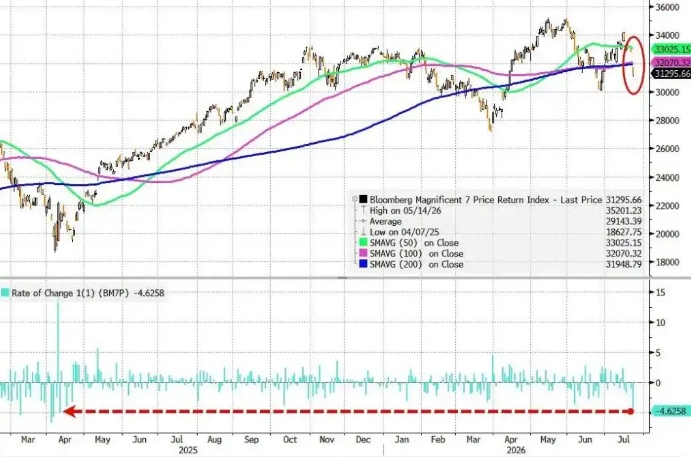
July 23, 2025, is a day that will go down in history for Wall Street. The "Magnificent 7" U.S. tech stocks saw a staggering $797 billion wiped from their combined market cap in a single trading session. This crash was swift and merciless, not just a routine market fluctuation, but a turning point in a era-defining narrative: Wall Street's attitude toward the artificial intelligence arms race has shifted from unconditional applause to harsh interrogation.
The S&P 500 fell 1.2% that day, the Nasdaq 100 dropped 1.9%, and the Mag 7 index plunged 4.8%—its worst single-day decline since the "tariff storm" in April 2025. Behind this disaster were not only bombshell earnings from tech giants but also macro pressure from rising oil prices due to escalating Middle East conflicts, together forming a "perfect storm."
The Trigger: Alphabet's Cash Flow Turns Negative for First Time, Tesla's Profit Misses Big
The direct cause of this mass sell-off came from the after-hours earnings reports of Alphabet and Tesla. The two reports exposed different yet mutually reinforcing problems: out-of-control capital spending and declining profitability.
Alphabet: The End of a Cash-Generating Machine?
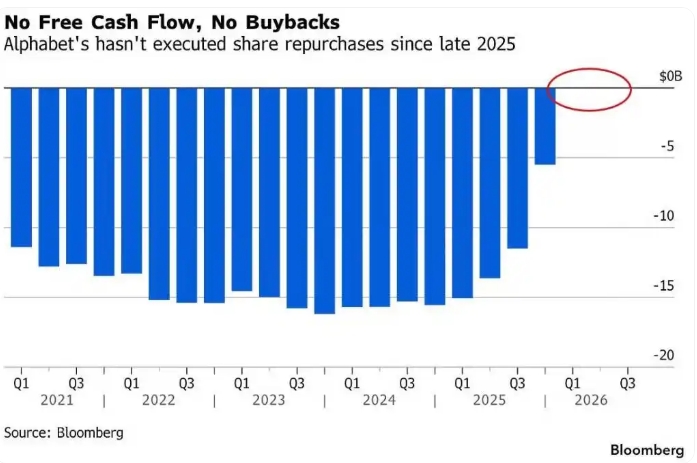
Alphabet's Q2 earnings initially looked strong—cloud computing business grew robustly, and net profit beat expectations by 216%. However, what truly shocked investors was its capex: a single-quarter capital expenditure of $45 billion, with the full-year ceiling raised to $205 billion. More critically, this massive spending pushed Alphabet's free cash flow into negative territory for the first time since the company went public.

Jason Lemire, Chief Investment Officer of Bold Wealth Partners, stated bluntly: "This shows the risk in this stock now is much greater than when it was a cash-generating machine in the past." Notably, Alphabet's cash flow went negative even as operating cash flow fell short of expectations—despite the massive profit beat, it couldn't "plug the hole" in capital spending. Additionally, Alphabet reported $10 billion in inventory, reflecting the deep transformation of the former search and advertising giant, but the cost of transformation is eroding its financial foundation.
Tesla: Profit Meltdown and "Burn Cash" Statement
Tesla's situation was similarly grim. Although revenue beat expectations, profit margins and earnings per share fell far short of analyst estimates. Even more unsettling was CEO Elon Musk's remarks during the earnings call—he told investors that Tesla "should spend capital expenditure as fast as possible—without being too wasteful, the faster the better," and called 2026 a "massive capex year."
This "burn cash" statement sent Tesla's stock plummeting 15% in a single day, its biggest daily drop since March 2025. Investor fear was palpable: a company that was supposed to focus on margin and cash flow improvement chose to continue aggressive expansion with unclear returns.
The stock performance of the two companies formed a mutually reinforcing tragedy: Alphabet fell 7.1%, its biggest single-day drop since May 2025; Tesla fared worse, down 15%.
Seven Giants Suffer Across the Board, Apple Becomes the Exception
All seven members of the Mag 7 fell, but with varying degrees. Tesla led the decline at -15%, followed by Alphabet at -7.1%, Amazon down 4.6%, Meta down 3.4%, and Microsoft down 2.2%. In this sea of losses, Apple's decline was the smallest, making it the only bright spot.
Apple managed to "escape" precisely because it largely stayed on the sidelines of the AI arms race, refraining from massive capital expenditure. Investors have recently begun to reward such "restraint"—Apple's stock has risen 11% month-to-date and 18% year-to-date. This stands in stark contrast to Alphabet and Tesla: as giants splurge on AI infrastructure, the market is questioning whether these investments will yield corresponding returns.
Notably, Microsoft, Amazon, and Meta are set to release earnings next week, and the market is already on alert for similar investor reactions. If these companies also report "surge in capex, pressure on margins," another round of sell-offs may be inevitable.
Divergence Between Semiconductor Index and Mag 7
A particularly noteworthy phenomenon in this crash was the relative resilience of chip stocks. The Philadelphia Semiconductor Index fell only 0.5% and is still up over 70% year-to-date. BTIG analyst Jonathan Krinsky dubbed the current situation "Hypershrinkers." He noted that in past historical data of major Mag 7 declines, when the Mag 7 fell -3% or deeper in a single day, the Philadelphia Semiconductor Index never recorded positive returns—but this time, the semiconductor index barely followed the drop.
How long can this divergence last? The market is watching closely. On one hand, this could indicate that the market is internally repricing tech stocks rather than experiencing systemic panic; on the other hand, if demand on the software and services side slows, it will eventually ripple into the semiconductor industry, making the divergence unsustainable.
Narrative Reversal: Money Burned, Where Are the Returns?
Behind this sell-off is an increasingly sharp question: Are these astronomical capital expenditures worth it?
Ken Mahoney, CEO of Mahoney Asset Management, hit the nail on the head: "The real issue is the scale of spending happening right now. No one knows what the ROI is." He added that macro factors, including rising oil prices from the escalation of the Iran war, are further pressuring these stocks. "It's a perfect storm."
Over the past three years, Wall Street had almost unconditionally cheered the massive AI investments—every new capital spending plan announcement would send stocks soaring. But now, that logic has completely reversed: if huge investments cannot translate into larger, concrete returns, stocks are immediately punished.
Lemire further noted: "These companies once had the healthiest balance sheets in U.S. corporate history; now they are becoming asset-heavy companies, and ROI has become an issue. This is a major shift in how investors see them—and that's not even counting the lack of transparency in their debt obligations over the next few years."
This shift is fundamental. From "pricing innovation" to "pricing efficiency," the market's valuation logic is undergoing a paradigm shift. For those companies most aggressive in AI infrastructure spending, they are being forced to answer a question all investors cannot avoid: When will this money actually be recouped?
Conclusion: The Moment of Truth for the AI Bubble Arrives
The crash on July 23, 2025, is likely to become a key turning point in the history of AI-themed investing. It not only reflects market disappointment with individual company earnings but also reveals Wall Street's shift from "infinite tolerance" to "harsh scrutiny" of AI capital spending. Against a backdrop of rising oil prices from Middle East conflicts and heightened macroeconomic uncertainty, the market's patience with the "burn cash for growth" model appears exhausted.
For investors, the key ahead lies in distinguishing which companies' capital spending can eventually generate real returns and which are simply blindly following the trend. For tech giants, this may be a signal to rethink strategic priorities: ambition alone is not enough; the market now demands concrete results.
This storm of trillions in market cap evaporation may ultimately give rise to a more rational era of tech investment—one where efficiency and return will once again be the core standards for measuring value.