


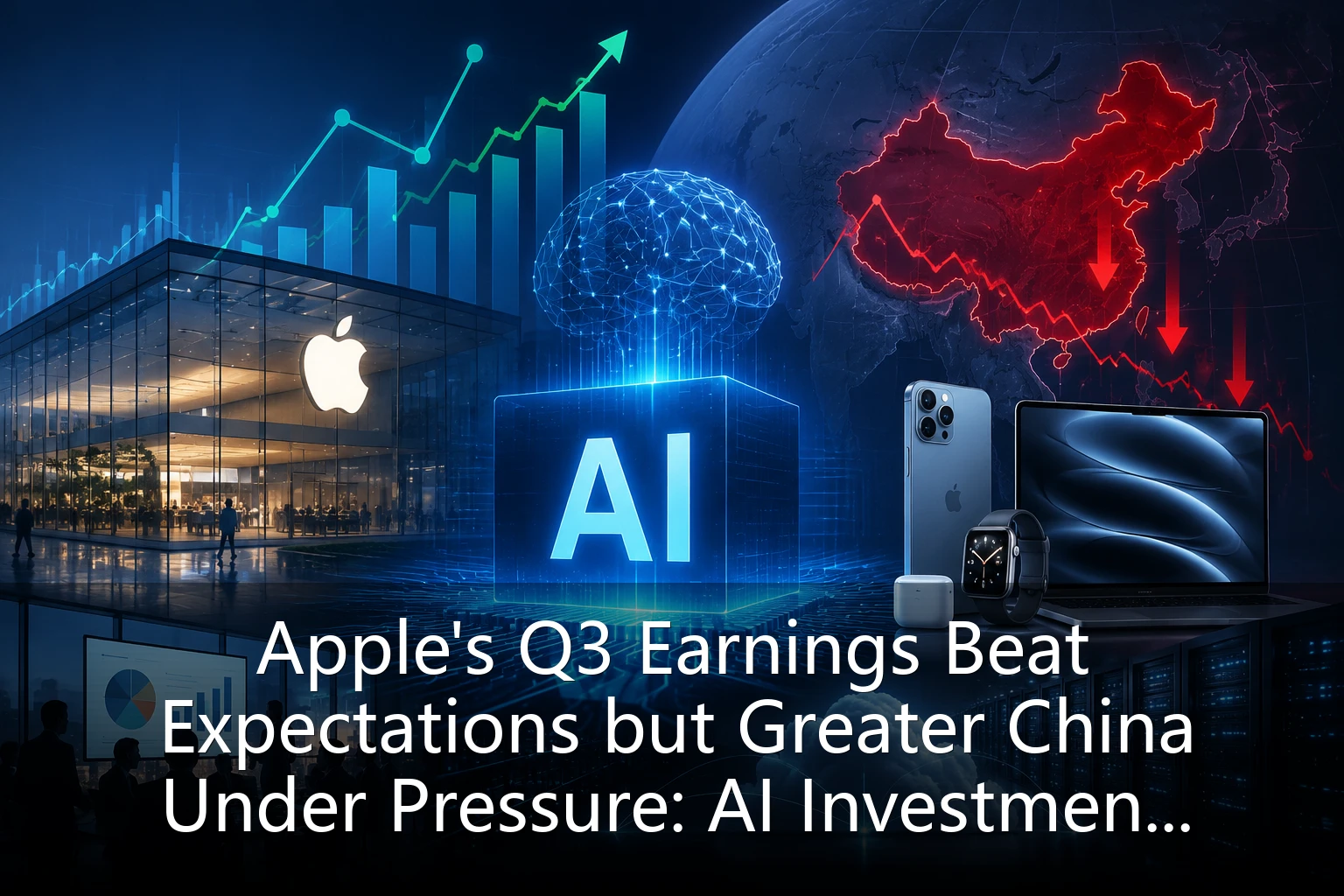
After hours on July 28, Eastern Time, Apple (AAPL) reported its fiscal Q3 2026 (ending June) earnings, with both revenue and EPS surpassing analyst expectations, sending the stock up over 1.5% in after-hours trading. However, concerns about weaker-than-expected Greater China revenue and AI-related massive capital expenditure squeezing profit margins caused the stock to retreat after the earnings call, eventually narrowing to near flat in after-hours trading.
1. Key Financial Data: Revenue and Profit Double Beat, Gross Margin Slightly Down
Apple's Q3 revenue reached $92.68 billion, up 4.2% YoY, above the consensus estimate of $91.0 billion; EPS was $1.56, up 11.4% from $1.40 a year ago, also beating expectations of $1.49. However, gross margin edged down 0.3 percentage points to 45.8%, primarily due to increased amortization from AI server and data center investments.
Services revenue hit a new high of $25.8 billion, up 14% YoY, with App Store, Apple Music, and iCloud subscription users surpassing 1 billion. iPhone revenue was $41.6 billion, up 1.2% YoY, in line with expectations but below some optimistic analysts' estimate of $43.0 billion.
2. Greater China Revenue Down 5%: Huawei Competition and Consumer Downgrade Pressure
The closely watched Greater China region (China, Hong Kong, Taiwan) revenue was $15.6 billion, down 5% from $16.4 billion a year ago, and below the market estimate of $16.2 billion. Cook noted on the call that competition in China has intensified, especially with Huawei's Mate 70 series and foldable phones capturing the high-end market, along with more cautious consumer spending, leading to an approximately 8% YoY decline in iPhone shipments.
However, Cook emphasized that on a constant currency basis, Greater China revenue only fell 2% YoY, and iPad and Mac sales in China still grew at a single-digit rate. Analysts believe that while Apple's market share in China is temporarily under pressure, services revenue grew 12% YoY to $7.5 billion, indicating strong ecosystem stickiness.
3. AI CapEx Doubles: Short-Term Profit Pressure, Long-Term Hope for New Cycle
Apple's capital expenditure this quarter reached $8.9 billion, double the $4.2 billion a year ago, primarily used to build AI servers and self-developed chip data centers. Cook said Apple Intelligence features will be fully integrated into the next-generation iPhone, iPad, and Mac in the second half of the year, expected to drive an upgrade cycle. However, the high hardware investment has already pressured gross margins, with CFO Luca Maestri estimating Q4 gross margin to further decline to between 44.5% and 45.5%.
Market reaction is divided. Optimists believe AI integration will significantly boost services revenue and hardware value added by fiscal 2027; pessimists point out that Apple's AI progress lags behind Microsoft and Google, and consumers' actual willingness to pay for AI features remains to be seen.
4. Treasury Stock and Dividends: Annual Buyback Maintained at $110 Billion
Apple's board announced an additional $90 billion in share repurchase authorization, maintaining the annual buyback at $110 billion, while raising the quarterly dividend by 4% to $0.26 per share. As of the end of Q3, Apple's cash reserves stood at $162 billion, still among the highest globally.
5. Institutional Views: Target Prices Diverge, Focus Shifts to iPhone 17 Launch
Following the earnings release, several Wall Street investment banks updated their ratings. Morgan Stanley maintained an "Overweight" rating with a target price of $260, bullish on the AI-driven upgrade cycle; Goldman Sachs lowered its target to $240, citing uncertainty in China's recovery. Apple's stock currently trades at $242, with a market cap of approximately $3.72 trillion, below Microsoft's $3.85 trillion, temporarily ranking as the world's second-largest company by market cap.
6. After-Hours Trading and Asia-Pacific Open Preview
Apple's after-hours stock first rose then fell, finally closing near flat, indicating that the market has largely digested the positive and negative factors in the earnings report. Looking ahead to the Asia-Pacific market open on the 29th, TSMC ADR, Hon Hai, and other Apple supply chain stocks may open higher and then decline, while Japanese and Korean semiconductor-related stocks should watch for negative effects from slowing Greater China demand.
Overall, Apple's Q3 earnings reinforced the market perception of "solid but slowing growth." Short-term, the stock will trade range-bound between the 180-day moving average ($238) and the previous high of $255. Investors should closely monitor the September iPhone 17 lineup's pricing strategy and the implementation of AI features, which will be the key catalyst determining whether Apple can reignite growth in fiscal 2027.
