Okay, this is a professional Traditional Chinese article created specifically for you based on the reference content and images you provided.
New Chapter of Bull Market Expansion: AI Adopters Take Over as the Next Growth Engine
Introduction: Market Rotation from the "Magnificent Seven" to "All Flowers Blooming"
This year, the US stock market has undergone a profound structural shift. The "Magnificent Seven," which dominated market trends and drove indices to new highs in past years, have begun to fade in glory. In their place emerges a broader and more resilient bull market pattern: winners are no longer limited to a handful of tech giants but are rotating toward industries that have been less favored by investors yet hold deep potential. This phenomenon not only marks a style shift but also heralds the arrival of a new investment era—from "creators and enablers of artificial intelligence" to the more critical "adopters of AI."
1. Market Shift: From Growth-Driven to Quality First
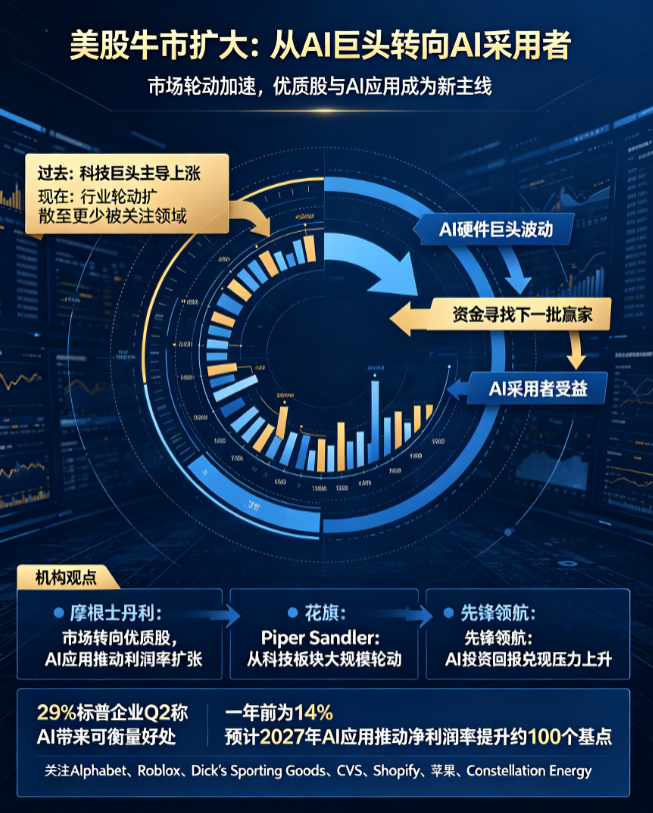
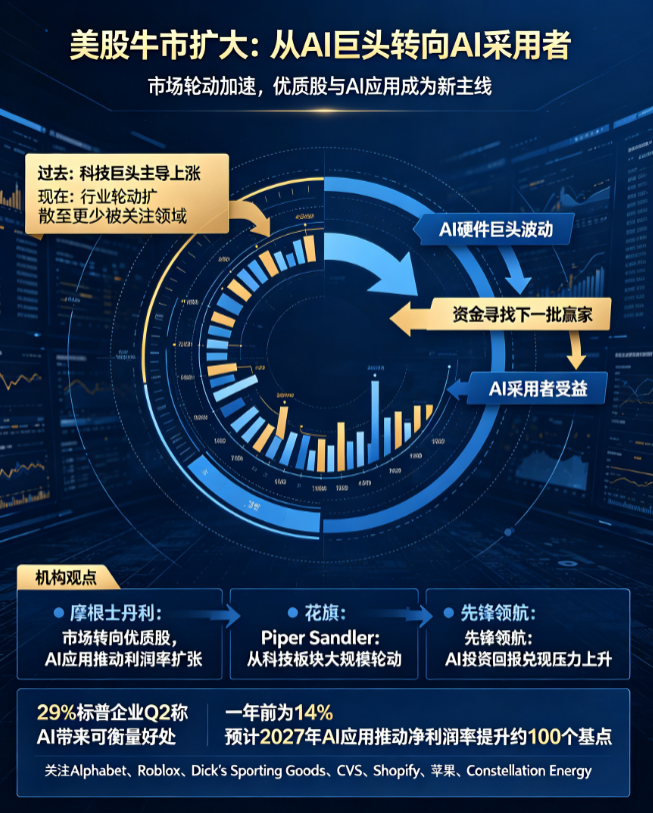
Mike Wilson, chief equity strategist at Morgan Stanley, accurately describes this phenomenon as a "typical mid-cycle transition during the maturation of the business cycle." As economic expansion enters its middle phase, market participants' focus naturally shifts from the early-stage "operational leverage"—boosting profits by scaling up—to more sustainable "margin expansion." Wilson points out that in the current phase, margin expansion will rely more on the widespread application of AI rather than mere operational efficiency improvements. This is the core logic behind his recent strong recommendation for "quality stocks."
In recent weeks, AI-related trades, especially those of chip manufacturers, have seen sharply increased volatility. Some once-hot star stocks have lost upward momentum, and Piper Sandler, a top Wall Street investment bank, even describes it as a "massive rotation" by investors from the tech sector into more defensive portfolios. Citigroup analysts bluntly state: "The 'Magnificent Seven' are outdated." All these signs indicate that the market is repricing, seeking the next growth driver to lead the trend.
2. Rise of AI Adopters: The Next Growth Engine
So, where is the market's next focus? The answer may lie within the "AI adopters."
According to Morgan Stanley's analysis, 25% of S&P 500 members reported in their second-quarter earnings calls that AI applications brought measurable business benefits, compared with only 14% a year ago. This data clearly shows that AI technology is accelerating from laboratory concepts to commercial applications and beginning to create real value for enterprises.
Wilson emphasizes: "We still believe that AI applications are an important source of earnings growth and operational leverage, and expect them to contribute about 100 basis points to net profit margins by 2027." This means that companies that can successfully integrate AI into their business processes—to save costs, enhance productivity, or even drive growth—will stand out in the next phase of competition.
Based on this, Morgan Stanley has also screened a batch of potential stocks considered "AI adopters," including well-known names such as Alphabet, Roblox, Dick's Sporting Goods, CVS, Shopify, Apple, and Constellation Energy Corporation. These companies span diverse sectors like technology, retail, healthcare, and energy, fully demonstrating that "AI adoption" is not exclusive to specific industries but a universal growth strategy.
The firm adds: "The increasingly bright outlook for AI applications, along with the numerous benefits from implementation, helps offset concerns about potential disruptive effects. This is especially important because some industries often considered vulnerable—including transportation, software and services, and professional services—are also among the most attractive adoption groups."
3. Investor Concerns: Pressure to Monetize Massive AI Investments
However, the market sentiment shift has not been smooth. Behind the flow of funds from the "Magnificent Seven" to other areas lies a core concern: Can the massive investments in AI by these mega-cap tech companies really deliver sufficient returns?
Shaan Raithatha, senior economist at Vanguard, points out: "The prevailing view now is that investors are increasingly questioning whether the huge capital expenditures by AI 'hyperscalers'—Alphabet, Amazon, Meta, Microsoft, and Oracle—can generate adequate returns given high expectations and intensifying competition." This doubt has directly led to volatility in the stocks of the "Magnificent Seven."
He further adds that while Vanguard expects investors to continue rotating into AI and companies supplying key components and memory chips, they anticipate continued volatility related to AI trades. Particularly noteworthy is the growing pressure from Chinese competitors, which will create new uncertainty for the current landscape.
4. Next Phase: From Tech Investment to Productivity Revolution
If the first phase of AI investment was infrastructure building, we are now at a critical inflection point from building to application. Vanguard writes in its report: "The next phase of AI development depends more on whether current investments can translate into productivity improvements across the broader global economy. History tells us that over time, the benefits of general-purpose technologies spread from the initial innovating industries to the entire economy."
This statement highlights the fundamental logic behind the rise of "AI adopters." When AI is no longer just an internal tool for the tech industry but permeates healthcare, retail, manufacturing, finance, and other sectors, ultimately enhancing the entire society's production efficiency, its potential value will far exceed current market expectations. Companies that can embrace and effectively utilize this general-purpose technology first will become leaders in the new round of economic growth.
Conclusion: Embracing the Value Revaluation Led by "AI Adopters"
In summary, the current rotation in the US stock market is not merely a style switch but an inevitable outcome of the economy and technology cycle entering a new phase. The first wave of AI investment led by the "Magnificent Seven" has laid the technological foundation for the market; the second, more critical phase will be carried forward by "adopters" who can turn AI into actual productivity and profit growth.
For investors, this means adjusting their perspective: no longer chasing leading concept stocks but shifting to examine companies' fundamentals and execution. Quality companies that can demonstrate cost savings, efficiency improvements, and revenue growth through AI, regardless of industry, are expected to receive higher valuations and market attention in the coming period. The bull market story continues, but the lead role has changed.