Global Market Turmoil: U.S. Stock Divergence Intensifies, Geopolitical Risks Push Up Oil and Gold Prices
Introduction
On July 29, 2024, global financial markets showed a complex picture under multiple factors. U.S. stock futures diverged, with the Dow Jones Industrial Average edging higher and the tech-heavy Nasdaq extending weakness. Meanwhile, international oil and precious metal prices surged, reflecting market concerns over geopolitical tensions. Against this backdrop, the sell-off in artificial intelligence (AI) related stocks intensified, and hedge fund leverage climbed to historic highs, sparking attention to systemic risk. This article deeply analyzes the day's market dynamics, explores the main driving forces behind them, and looks ahead to possible future trends.
Market Dynamics: U.S. Stock Divergence and Tech Stock Pressure
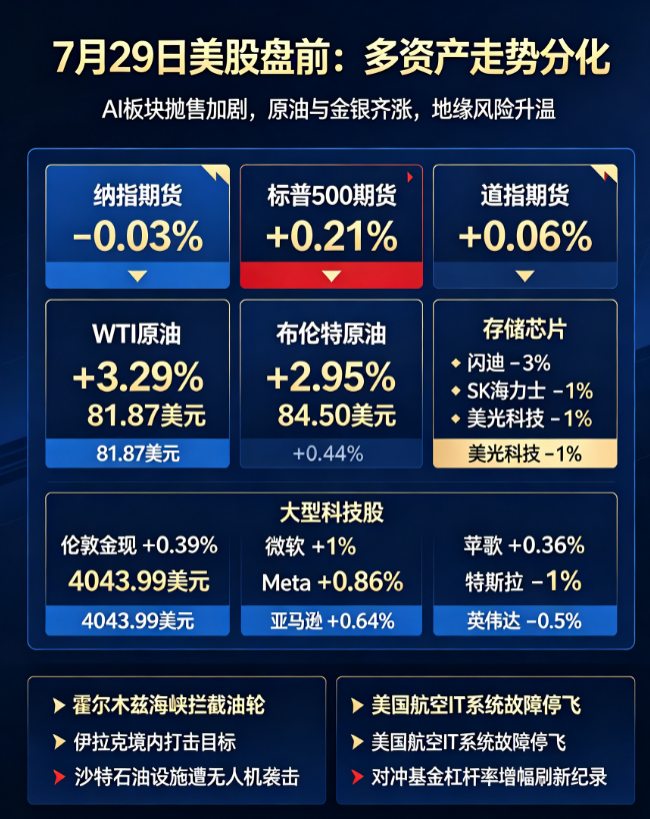
During pre-market trading, the three major index futures were mixed. Dow futures rose 0.06%, S&P 500 futures added 0.21%, while Nasdaq 100 futures edged down 0.03%. This divergence mainly stemmed from continued downward pressure on tech stocks.
Among large tech stocks, shares of Microsoft, Meta, Amazon, and Apple rose in pre-market but with limited gains. In contrast, Tesla fell over 1%, and NVIDIA dropped 0.5%, extending the recent weakness in the AI sector. Notably, memory chip stocks continued to slide pre-market, with SanDisk falling over 3%, and SK Hynix and Micron Technology dropping over 1%. This indicates deepening market concerns over semiconductor demand prospects and inventory adjustments.
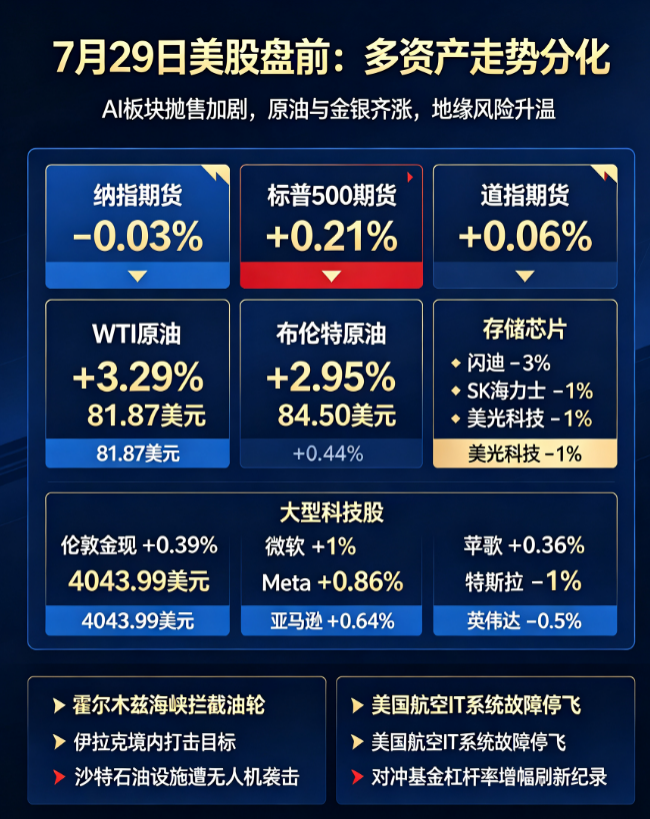 Chart: Pre-market major indices and individual stock performance on July 29, 2026
Energy and Precious Metals: Geopolitical Risks Fuel Safe-Haven Demand
Against escalating geopolitical tensions, international oil prices rose significantly. As of press time, West Texas Intermediate (WTI) crude futures gained 3.29% to $81.87 per barrel; Brent crude futures rose 2.95% to $84.50 per barrel. The jump was driven by two factors: first, U.S. forces struck "Iranian-backed" targets in Iraq, aggravating Middle East turmoil; second, Iran's Islamic Revolutionary Guard Corps intercepted three alleged "violating" oil tankers in the Strait of Hormuz, disrupting a key global energy transport chokepoint.
Precious metals markets also performed strongly. London spot gold rose 0.39% to $4,043.99 per ounce; London spot silver increased 1.77% to $58.121 per ounce. As a traditional safe-haven asset, gold continued to attract inflows amid geopolitical risks and inflation expectations. Silver, driven by both industrial demand and risk aversion, saw more significant gains.
AI Sector Sell-Off Intensifies: Hedge Fund Leverage Hits Highs, Raising Warnings
Recently, the sell-off in U.S. AI-related stocks has become a market focus. The Financial Times reported on the 29th that as the AI sector reversed, multiple mainstream trading strategies incurred heavy losses, prompting major Wall Street banks to issue margin calls to hedge funds in recent weeks. This highlights deep concern over the speed and depth of the AI sector's decline.
Data shows that over the past two weeks, the Nasdaq 100 briefly entered a technical correction zone, with the chip sector particularly hit by concentrated selling. Previously, the AI track was heavily favored by hedge funds, but this sell-off has completely reversed the sector's uptrend. Regulators and market participants are watching whether continued selling could trigger a chain reaction on the entire financial system.
Geopolitical Shadow: Iran-U.S. Tensions Escalate
Geopolitical risk was a core reason for the day's market turmoil. The U.S. Central Command announced on the 28th that U.S. and Saudi forces struck "Iranian-backed" targets in Iraq. The U.S. stated that between February and April this year, "Iran-backed militias" launched over 600 attempted attacks against U.S. citizens and facilities in Iraq.
However, Iran strongly denied involvement. Iranian state television on the 29th quoted a military intelligence official saying Iran had no connection to the attacks in Saudi territory, and accusing such attributions as "serious misjudgment." Meanwhile, the Saudi Defense Ministry reported on the 27th that its air defenses intercepted and destroyed several drones from Iraq attempting to attack Saudi oil facilities. These conflicting narratives heightened market uncertainty.
Additionally, Iran's Islamic Revolutionary Guard Corps announced on the 29th that it intercepted three oil tankers deemed "violating" in the Strait of Hormuz. The Strait is one of the world's most critical oil transport routes, handling about one-third of global oil trade. Any disruption in the region could cause sharp oil price swings and threaten global energy security.
Other Market Events: U.S. Airline System Failure and Weather Impact
Beyond geopolitical risks, the U.S. airline industry also faced a sudden incident. American Airlines temporarily grounded all flights nationwide on the evening of the 28th due to an IT system failure. Operations resumed after troubleshooting, but this event, coupled with thunderstorm impacts at multiple East Coast airports that day, led to widespread flight delays and cancellations. According to flight tracking data, American Airlines had over 1,000 flight delays and more than 200 cancellations that day.
Conclusion and Outlook
Overall, the market performance on July 29, 2026 was the result of multiple factors. U.S. stocks showed clear divergence, with selling pressure on tech stocks, especially the AI sector, continuing to increase; hedge fund leverage surging raised concerns about potential risks. On the other hand, geopolitical tensions in the Middle East, particularly escalating U.S.-Iran confrontation, directly pushed up oil and precious metal prices, with risk aversion dominating the market.
Looking ahead, investors need to closely monitor several key variables: first, when the AI sector adjustment will bottom, and whether hedge funds will be forced to further reduce positions; second, whether the Middle East situation will escalate into a larger conflict, particularly the shipping safety in the Strait of Hormuz; and finally, monetary policy moves by the Federal Reserve and other major central banks, which will also have a profound impact on global asset pricing. In this highly uncertain environment, the importance of diversified allocation and risk management becomes increasingly prominent.