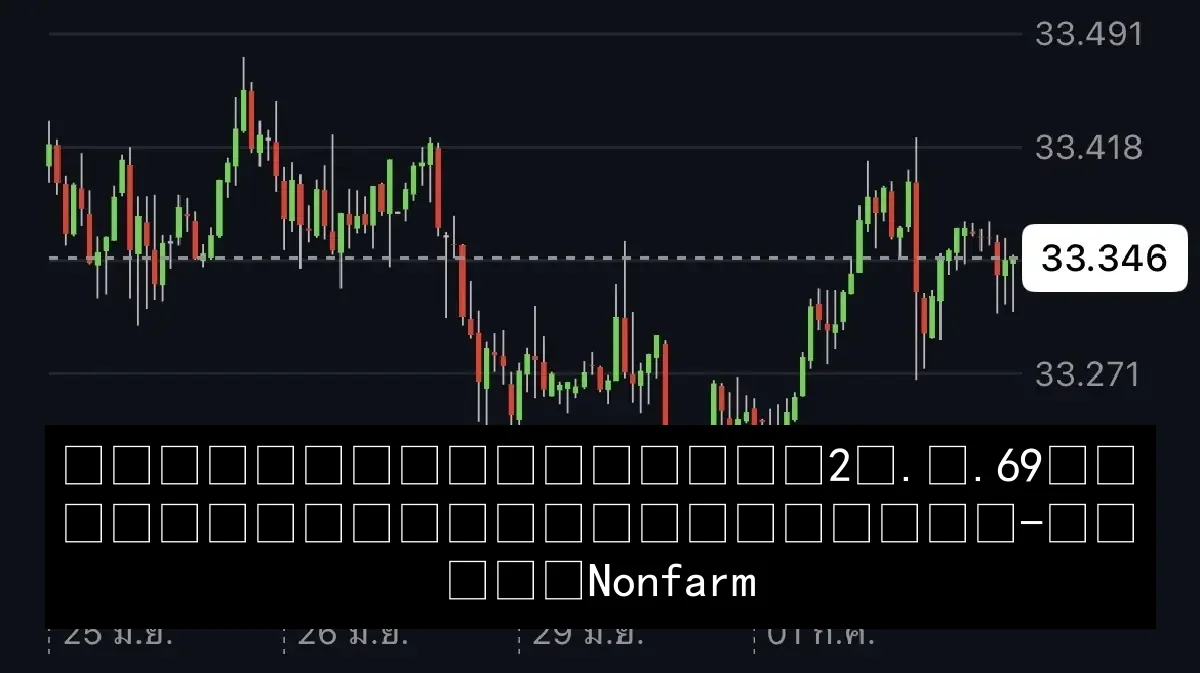
Thai baht weakens today (July 2) Dollar support - watch NFP
Thai baht today: Opens weaker at 33.33 baht per USD
Thai baht opened on July 2 at 33.33 baht per USD; Krungthai Bank said the dollar is supported by expectations that the FED may raise rates, and expects today's baht trading range to be 33.15-33.55 baht per USD.
Key points summary
- The baht opened at 33.33 baht per USD, slightly stronger than the previous day's close, but the overall trend still points to depreciation as the dollar strengthens.
- The dollar is supported by market expectations that the Federal Reserve (FED) may raise rates.
- Short-term volatility drivers to watch: the release of U.S. employment data and selling pressure in AI stocks.
Krungthai Bank's Krungthai GLOBAL MARKETS currency market strategist Poon Panichphibul said the baht opened this morning at 33.33 baht per USD, slightly stronger than the previous day's close of 33.38 baht per USD, and expects today's baht range to be 33.15-33.55 baht per USD.
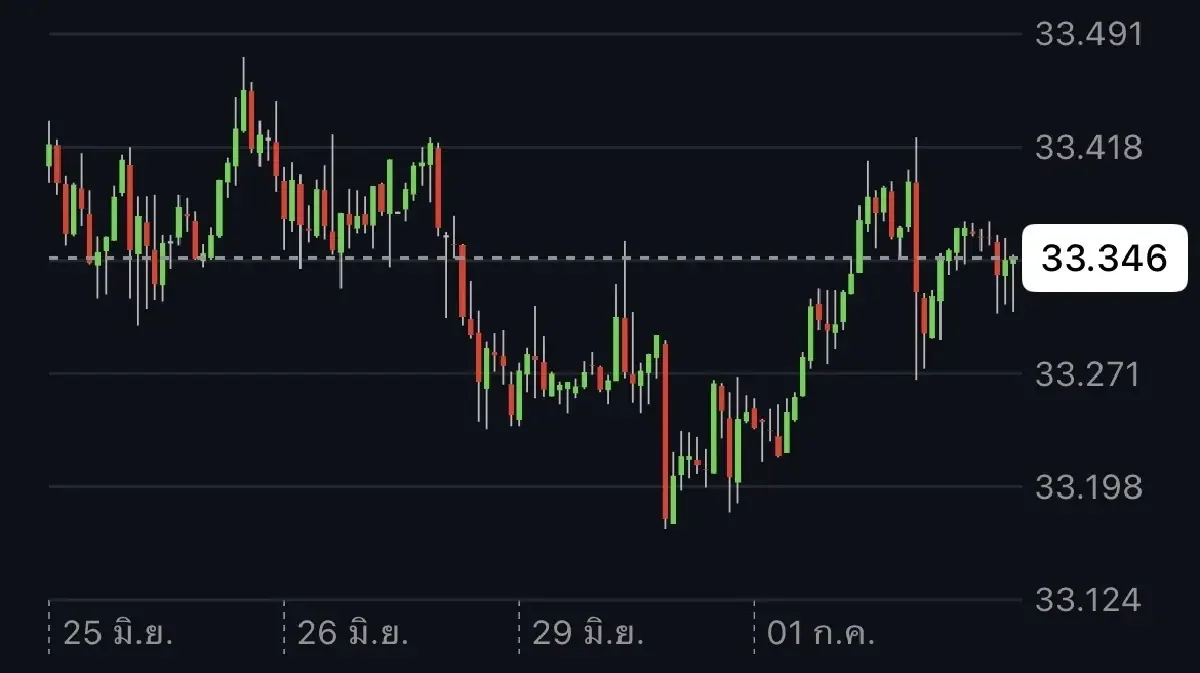
Since last night, the baht has been in a sideways-down move, trading in a range of 33.26-33.43 baht per USD, with occasional depreciation as the dollar gradually strengthened, boosted by higher odds of a FED rate hike.
Market participants reacted to the Challenger Job Cuts survey report coming in better than expected and adjusted positions ahead of remarks by FED Chair Kevin Warsh at the ECB symposium in Sintra, after which the baht recovered somewhat.
Dollar supported by rate-hike expectations, while gold is dragged by AI/semiconductor selling pressure
FED Chair Kevin Warsh said the high-risk outlook for U.S. inflation has gradually eased, leading market participants to reduce expectations for FED rate hikes this year, from about a 56% chance of two hikes to about 33%, pressuring the dollar and U.S. 10-year Treasury yields lower while supporting gold prices (XAUUSD) to rise.
However, baht appreciation and the rise in gold prices were capped and slowed, as the dollar still received some support. The market raised the probability of two rate hikes this year to 43%, awaiting Thursday's U.S. nonfarm payrolls report, while selling pressure in AI/semiconductor stocks also supported the dollar and weighed on gold.
Baht outlook: Two-way risks and a test of the 33.50 level
We maintain our view that the baht faces two-way risks in the near term, depending on developments in the Middle East, until the United States and Iran sign a peace agreement and the Strait of Hormuz is formally reopened. Market participants should use more diversified hedging strategies, especially options strategies.
Intraday, selling pressure in U.S. and European AI/semiconductor stocks may continue to spill over into similar Asian stocks, as in the past, and pressure Asian currencies. The baht should watch how much foreign investors sell Thai stocks, especially AI/semiconductor names.
If AI/semiconductor selling pressure persists, it could further weigh on the baht via weaker gold prices, as risk reduction and liquidity adjustments take hold. But we think baht depreciation is limited, because market participants may wait for clearer U.S. labor data before adjusting positions.
If AI/semiconductor selling pressure intensifies and is reflected in U.S. labor market data, it could raise the risk of a Second Round Effect and a Wage-Price Spiral. We estimate the baht may weaken to test the 33.50 resistance zone; if gold falls sharply, it could break again, with the next resistance at 33.75 baht per USD.
In the event of a sharp risk-off move in financial markets, watch for volatility from yen position adjustments or an unwind of the JPY carry trade, as market participants' yen short positions are close to 2024 levels. Such a move could lead to a sharp yen rally, slowing baht depreciation and supporting a stronger baht in the short term.
However, sustained strength in both the yen and the baht would only occur if the FED rate-hike narrative changes materially, shifting from firm expectations of hikes to rates being held or even cut.
Market participants should watch for volatility around 19:30 Thailand time as the market gradually digests the U.S. employment report.
We maintain that the baht still faces depreciation pressure due to the dollar's upward momentum, until market participants scale back rate-hike expectations for the FED, which may require key economic data, especially inflation figures. But if tensions in the Middle East flare up again and push energy prices higher, the odds of a FED rate hike could rise, continuing to pressure the baht.
For now, we keep our view unchanged: the baht remains in a depreciation trend, or at least in sideways trading; technically, following a trend-following strategy, this remains the case until the baht clearly breaks through the 32.50 support zone on the weekly chart and turns stronger.
Global financial market view: equity pressure - watch NFP and Europe-related factors
Although U.S. stocks were partly supported by a sharp rise in Meta, after reports said Meta will push ahead with its cloud business to let customers use more AI services, and the FED chair's remarks slightly lowered rate-hike expectations, the market was once again dragged down by selling in AI/semiconductor stocks. Micron fell 10.6%, sending the S&P 500 down 0.22% and the Nasdaq down 0.66%.
In Europe, the STOXX 600 fell 0.38%, weighed down by a 4.6% drop in ASML as the market worried about earnings prospects and lofty valuations in the sector. Lower energy prices also hit energy stocks, such as BP, which fell 2.4%. However, markets were still supported by lower rate-hike expectations for the ECB and BOE, after eurozone CPI came in below expectations and by remarks from ECB officials at the annual forum in Sintra, Portugal.
U.S. 10-year Treasury yields moved in a 4.45%-4.50% range, most recently around 4.48%, with the trend depending on Middle East developments and U.S. economic data that affect the FED rate outlook. We still recommend gradually buying long-duration bonds when the 10-year yield rises above 4.50%, as two-way risk still remains.
In FX, the dollar is trading sideways. Despite pressure from mixed economic data, selling in AI/semiconductor stocks and the chance of yen weakness continue to support a rebound in the dollar, keeping the U.S. Dollar Index (DXY) around 101.4 points (101.2-101.6). Gold is trading around 4,050 USD per ounce.
Over the next 24 hours, the focus is on U.S. labor market data, including Nonfarm Payrolls, the unemployment rate, and average hourly earnings, as well as durable goods orders, which may affect the FED rate outlook. Also watch remarks from European Central Bank officials, developments in the Middle East, and the performance of tech stocks, especially AI/semiconductor names.